
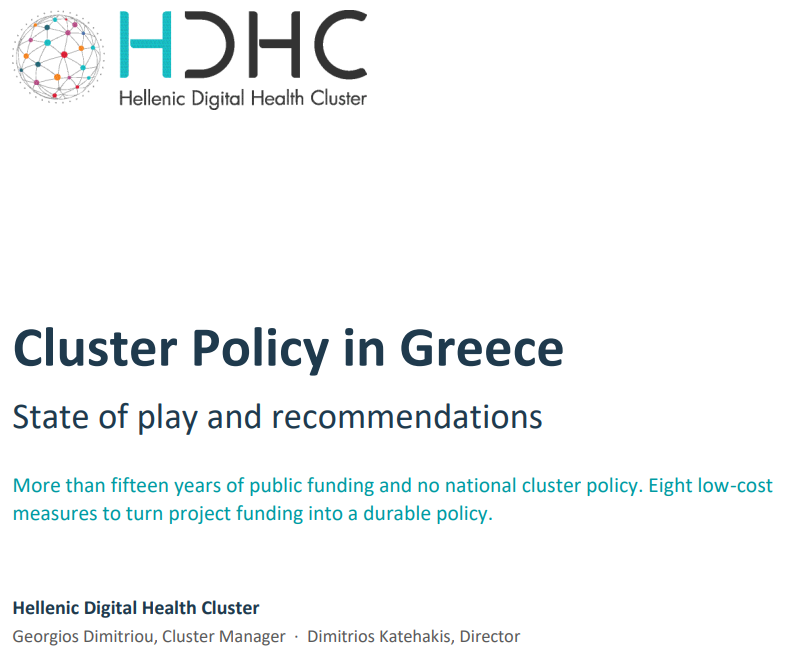
Greece has supported cluster development through funding programmes for more than 15 years. However, despite this investment, the country still lacks a coherent national cluster policy that ensures continuity, recognition and long-term sustainability for cluster organisations.
The "Cluster Policy in Greece: State of play and Recommendations" Memo, prepared by the Hellenic Digital Health Cluster (HDHC), examines the current situation and proposes practical measures to strengthen the national cluster ecosystem. The memo was shared during the Clusters Meet Regions Attica event, organised on 06-07/10/2026 by the European Cluster Collaboration Platform (ECCP) in cooperation with the Region of Attica. It highlights the need to move beyond fragmented project-based funding towards a coordinated approach to cluster development.
Current challenges
The memo identifies key challenges facing Greek clusters.
1. The absence of a common policy framework
Successive funding programmes have adopted different definitions and models of clusters, ranging from facilitator organisations to business partnerships and value-chain consortia. As a result, cluster organisations often struggle to build institutional capacity and maintain recognition beyond individual funding cycles.
2. Limited continuity despite significant investment
Around €110 million in public expenditure has been allocated to cluster-related programmes over the years. Nevertheless, many cluster organisations have faced difficulties sustaining their operations once project funding ended. This highlights the need for funding mechanisms that support long-term development rather than isolated projects.
3. Limited systematic evaluation
There is no comprehensive assessment of how many of the approximately 50–60 clusters supported through successive programmes remain operational or which interventions have generated lasting results. Better monitoring and evaluation are needed to understand the impact of public investment and inform future policy decisions.
Recommendations for a national cluster policy
To address these challenges, the memo proposes a set of practical measures designed to improve coordination, strengthen cluster organisations and make better use of existing resources. The recommendations include:
- Establishing a national cluster policy with a shared definition, clear objectives and a coordinated framework for cluster development.
- Creating a national cluster registry and recognition framework to improve visibility and provide continuity across funding programmes.
- Introducing multiannual base funding for recognised clusters to support their core operations and long-term activities.
- Introducing a cluster bonus in European Regional Development Fund (ERDF) calls to encourage collaboration through established cluster organisations.
- Supporting quality labels and professional development, including European Secretariat for Cluster Analysis (ESCA) quality labels and training for cluster managers.
- Co-financing cluster contributions to European projects to help organisations participate in international partnerships and initiatives.
- Implementing systematic evaluation to assess cluster performance, the effectiveness of funding instruments and the long-term impact of public investment.
A more coherent cluster policy could help Greece make better use of the organisations and collaborative networks already operating across its regions and sectors. By providing a clearer framework for recognition, funding and evaluation, national policy can support clusters in connecting businesses, research organisations, public authorities and other stakeholders.
As highlighted in the ECCP's input paper for the event, stronger links between existing organisations and support instruments are an important priority. The HDHC memo builds on this approach, outlining how Greece could move towards a more sustainable and coordinated national cluster ecosystem.
The present memo was prepared by the Hellenic Digital Health Cluster, with contributions from George Dimitriou and Dimitrios G. Katehakis, and is intended to support discussion on the future direction of cluster policy in Greece.